
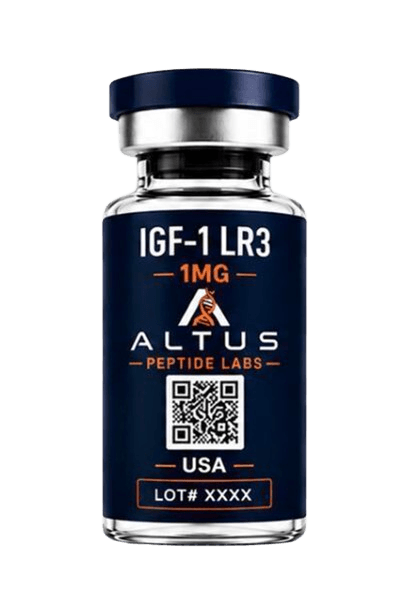
IGF-1 LR3
$53.00
Synthetic analog of human Insulin-Like Growth Factor-1 (IGF-1) Contains an arginine substitution at position 3 and an extended chain Research-grade Supplied as a lyophilized powder for laboratory research
IGF-1 LR3 1mg — Long R3 Insulin-Like Growth Factor-1
Why the “Long R3” modification matters
In circulation, native IGF-1 is almost entirely bound by IGFBP-1 through IGFBP-6, leaving only a small free fraction available to the receptor. The Arg3 substitution weakens IGFBP binding while the N-terminal extension stabilizes the molecule, so Long R3 IGF-1 remains free far longer than native IGF-1. This property was first exploited in mammalian cell-culture research, where Long R3 IGF-1 became a standard supplement for sustaining the viability and productivity of cultured cells in reduced-serum media.
Specifications
| Analog | 83-residue IGF-1 analog (Arg3 substitution + 13-residue N-terminal extension) |
| Molecular Weight | ~9111 g/mol |
| CAS Number | 946870-92-4 |
| Molecular Purity | See COA |
| Form | Lyophilized powder |
| Reconstitution | Bacteriostatic (BAC) water |
| Storage | Cool, dry, away from direct light |
| Quantity | 1mg per vial |
Research areas
IGF-1 receptor signaling
Studied for activation of the IGF-1 receptor and the downstream PI3K/Akt and MAPK cascades that govern cellular growth, proliferation, and survival.
Cell-culture research
A standard supplement in serum-free and reduced-serum mammalian cell culture, studied for its ability to sustain cell viability and product yield.
Protein-synthesis models
Investigated in skeletal-muscle and connective-tissue models for its role in protein-synthesis signaling and cellular hypertrophy and hyperplasia pathways.
Metabolic research
Examined for cross-talk with insulin signaling and glucose-uptake pathways in metabolic research models.
Research applications
- Studied in IGF-1 receptor and PI3K/Akt signaling research
- Used as a supplement in mammalian cell-culture models
- Relevant to protein-synthesis and tissue-growth pathway research
- Investigated in metabolic and nutrient-partitioning models
- Used to study sustained IGF-axis activation versus native IGF-1
For research use only. Not for human consumption.
Related products
-
GLP-1 & Metabolic
TESAMORELIN
$105.00 Select options This product has multiple variants. The options may be chosen on the product page
Reviews
There are no reviews yet.