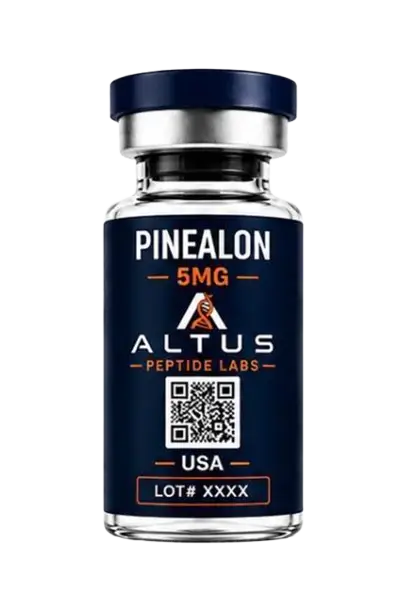
PINEALON
$60.00
Pinealon is a synthetic tripeptide (Glu-Asp-Arg) used in laboratory research for cellular regulation and gene expression studies. Synthesized via SPPS and HPLC-purified, it ensures analytical-grade purity for controlled biochemical research and assay applications.
- Certificate of Analysis available for every lot
- ≥99% purity, HPLC & mass-spec verified
- Ships from a U.S. facility — same-day before 12pm CT
- Secure checkout · Free shipping on orders $300+
Pinealon Product Specifications
The following specifications describe commonly reported Pinealon characteristics. Confirm the supplier’s current batch documentation before publishing final product details.
| Specification | Details |
| Compound | Pinealon (EDR) |
| Peptide Type | Synthetic tripeptide |
| Amino Acid Sequence | Glu-Asp-Arg (EDR) |
| Peptide Length | 3 amino acids |
| Research Focus | Neurobiology and cellular signaling |
| Molecular Formula | Verify product documentation |
| Molecular Weight | Verify product documentation |
| Quantity | Confirm available vial size |
| Purity | Confirm batch-specific analysis |
| Intended Use | Laboratory research only |
Molecular information should be checked against the precise form and analytical records supplied with the product.
Molecular Structure and Peptide Research
Pinealon’s short amino acid sequence provides a defined starting point for molecular characterization. The peptide contains glutamic acid, aspartic acid, and arginine, three amino acids with different chemical properties that influence peptide structure and interactions.
Researchers studying short peptides often examine how sequence composition relates to molecular behavior. Factors such as charge, solubility, stability, and interactions with other biological molecules can influence experimental observations.
Pinealon is therefore relevant to investigations that seek to understand the relationship between peptide structure and cellular processes.
However, the presence of a particular amino acid sequence does not, by itself, establish a specific biological effect. Research conclusions should rely on validated experiments and relevant scientific evidence.
Pinealon in Neurobiology Research
Pinealon has been investigated in scientific literature concerning neuronal function and cellular aging-related mechanisms. These research areas involve complex biological pathways, including gene expression, cellular stress responses, and molecular regulation.
Researchers may use Pinealon as a subject for examining potential interactions within these systems. The exact relevance of the peptide depends on the experimental model and the specific research question.
Neuronal Signaling Investigations
Laboratories can explore molecular pathways associated with neuronal cells and investigate how peptide-related interactions may influence experimental observations.
Cellular Stress Research
Pinealon-related research may provide context for studying cellular responses to stress and the molecular mechanisms involved in maintaining cellular function.
Aging Biology
Researchers investigating cellular aging may examine peptide-associated signaling and gene-regulatory processes in suitable experimental systems.
Peptide Structure-Function Studies
The tripeptide sequence offers a defined molecular structure for comparative characterization, including investigations into sequence-dependent properties.
These areas represent potential research directions rather than established outcomes for every experimental system.
Analytical Characterization and Quality Considerations
Short peptides require accurate identity confirmation, particularly when products are supplied under different names or formulations. Pinealon should be evaluated using documentation specific to the material being purchased.
Before incorporating the peptide into laboratory research, review relevant information such as:
- Confirmed amino acid sequence
- Molecular identity
- Batch or lot identification
- Purity analysis
- Formulation details
- Storage recommendations
Analytical testing should be appropriate to the peptide’s characteristics. HPLC and mass spectrometry may be relevant to peptide characterization, depending on the laboratory’s objectives and available methods.
Purity claims should reflect verified batch documentation rather than assumed specifications.
Research Applications and Experimental Planning
Pinealon may be incorporated into laboratory studies involving peptide characterization, neurobiology, and cellular signaling. Researchers should define the purpose of the experiment before selecting analytical methods or interpreting results.
For example, a peptide identity study requires different considerations from a cell-based signaling investigation. Appropriate controls, validated methods, and clearly documented experimental conditions help support reliable conclusions.
The use of Pinealon in a research model does not establish that results will translate to other biological systems.
Storage and Handling Guidance
Pinealon should be stored according to the supplier’s validated recommendations for the specific formulation.
Researchers should review product documentation for temperature requirements, environmental protection, and handling procedures. Storage conditions may differ between lyophilized material and prepared solutions.
Avoid assuming reconstitution instructions or stability periods without verified product-specific guidance.
Frequently Asked Questions
1. What is Pinealon?
Pinealon is a synthetic tripeptide commonly identified by the amino acid sequence Glu-Asp-Arg (EDR).
2. How many amino acids does Pinealon contain?
Pinealon is commonly described as a three-amino-acid peptide.
3. What research areas involve Pinealon?
Research areas may include neurobiology, cellular signaling, peptide characterization, and cellular aging-related investigations.
4. Is Pinealon the same as P21?
No. Pinealon and P21 are different peptide materials with distinct molecular identities and sequences.
5. Is Pinealon intended for human use?
No. This product is intended for laboratory research only and is not for human or veterinary use.
Explore Pinealon Research Material
Pinealon provides laboratories with a defined short-peptide model for investigating molecular characteristics and biological signaling mechanisms. Its three-amino-acid structure makes accurate identification and appropriate analytical documentation especially important.
Review the available product specifications, purity records, and handling recommendations before selecting Pinealon for your research workflow.
Research use only. Not for human or veterinary use
Reviews
There are no reviews yet.