
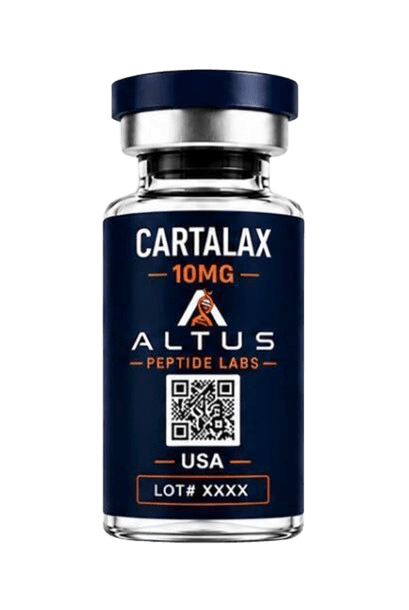
CARTALAX
$60.00
Cartalax is a short synthetic peptide commonly identified by the sequence Ala-Glu-Asp (AED). Also referenced as T-31 in some research literature, Cartalax belongs to the group of short peptide bioregulators associated with the Khavinson research tradition.
This compound is of interest in laboratory research involving short-chain peptide chemistry, cellular signaling, gene-expression studies, and connective-tissue-related biology. However, the available evidence remains limited, and product identity should always be confirmed through reliable analytical documentation.
Research use only. Not for human or veterinary use.
Cartalax Peptide Specifications
| Property | Details |
| Product Name | Cartalax |
| Alternative Designation | AED, T-31 |
| Peptide Sequence | Ala-Glu-Asp |
| Peptide Type | Synthetic tripeptide |
| Molecular Formula | C₁₂H₁₉N₃O₈ |
| Molecular Weight | Approximately 333.29 g/mol |
| Physical Form | Typically supplied as a lyophilized powder |
| CAS Number | Not reliably established |
| Intended Use | Laboratory research and analytical applications |
The sequence and molecular profile listed above correspond to Cartalax as the Ala-Glu-Asp tripeptide. Because different commercial and secondary sources may provide conflicting identity information, researchers should verify the sequence, molecular mass, salt form, and purity against the batch-specific Certificate of Analysis (COA).
What Is Cartalax?
Cartalax consists of three amino acid residues: alanine, glutamic acid, and aspartic acid. In one-letter notation, its sequence is written as AED. Its short structure makes it distinct from related compounds such as Epitalon, which contains the additional glycine residue and is written as Ala-Glu-Asp-Gly (AEDG).
This distinction is important when reviewing scientific papers, supplier listings, or analytical reports. Cartalax should not automatically be treated as interchangeable with other short peptides that share part of its sequence.
The compound is often discussed within the broader category of tissue-associated short peptide bioregulators. Nevertheless, the proposed biological roles of Cartalax should be considered exploratory rather than established. Published information does not provide sufficient independent evidence to support definitive claims about specific physiological outcomes.
Research Relevance and Scientific Interest
Cartalax may be included in laboratory investigations examining the relationship between short peptide structures and cellular activity. Researchers may be interested in its:
- Short-chain peptide structure: Useful for studying the chemical characteristics of low-molecular-weight peptides.
- Sequence-specific behavior: Supports research into how individual amino acid arrangements influence molecular interactions.
- Cellular signaling research: May be evaluated in controlled experimental systems examining peptide-related signaling pathways.
- Gene-expression studies: Can be considered in exploratory research involving transcriptional responses and cellular regulation.
- Comparative peptide analysis: Provides a reference compound for comparing tripeptides and structurally related peptide sequences.
These areas describe potential research directions rather than confirmed mechanisms or validated applications. Experimental findings should be interpreted within the limitations of the selected model, assay design, controls, and analytical method.
Identity Verification and Quality Considerations
Accurate compound identification is essential when working with Cartalax. Some online sources have associated the name with different peptide sequences, including longer related peptides. For this reason, researchers should not rely solely on a product title or marketplace description.
Before beginning an experiment, review the available documentation for:
- Confirmed amino acid sequence and terminal modifications
- Reported molecular weight and molecular formula
- Purity testing method, such as HPLC
- Identity confirmation through mass spectrometry
- Batch or lot number
- Manufacturing and handling information
A well-prepared COA should correspond to the specific lot supplied. If the product documentation does not clearly identify the compound, additional verification may be appropriate before laboratory use.
Handling and Storage
Cartalax is commonly supplied as a lyophilized research material. Storage requirements can vary depending on the formulation, packaging, and supplier specifications. Researchers should follow the handling instructions provided with the individual batch.
Keep the material protected from unnecessary exposure to moisture, heat, and light. Any reconstitution, preparation, or analytical handling should be performed according to an established laboratory protocol and appropriate institutional procedures.
Frequently Asked Questions
What is Cartalax?
Cartalax is commonly identified as a synthetic tripeptide with the amino acid sequence Ala-Glu-Asp (AED), also associated with the designation T-31.
Is Cartalax the same as Epitalon?
No. Cartalax is generally described as Ala-Glu-Asp, while Epitalon is Ala-Glu-Asp-Gly. The additional glycine makes them chemically distinct peptides.
What is the molecular weight of Cartalax?
The commonly reported molecular weight for the Ala-Glu-Asp structure is approximately 333.29 g/mol. This value should be compared with the supplier’s analytical documentation.
How should Cartalax be evaluated?
Researchers should assess the compound through sequence verification, analytical testing, batch documentation, and carefully designed laboratory controls.
Is Cartalax intended for human use?
No. This product is intended exclusively for laboratory research, testing, and analytical applications. It is not for human or veterinary use.
Order Cartalax for Laboratory Research
Cartalax offers researchers a short peptide structure for exploratory investigations involving peptide chemistry and cellular research. Review the available specifications and batch documentation before selecting the material for your laboratory workflow.
Research use only. Not for human or veterinary use.
Related products
-
GLP-1 & Metabolic
MOTS-C
Price range: $35.00 through $119.00 Select options This product has multiple variants. The options may be chosen on the product page
Reviews
There are no reviews yet.